 Join WhatsApp Group
 Follow us on LinkedIn
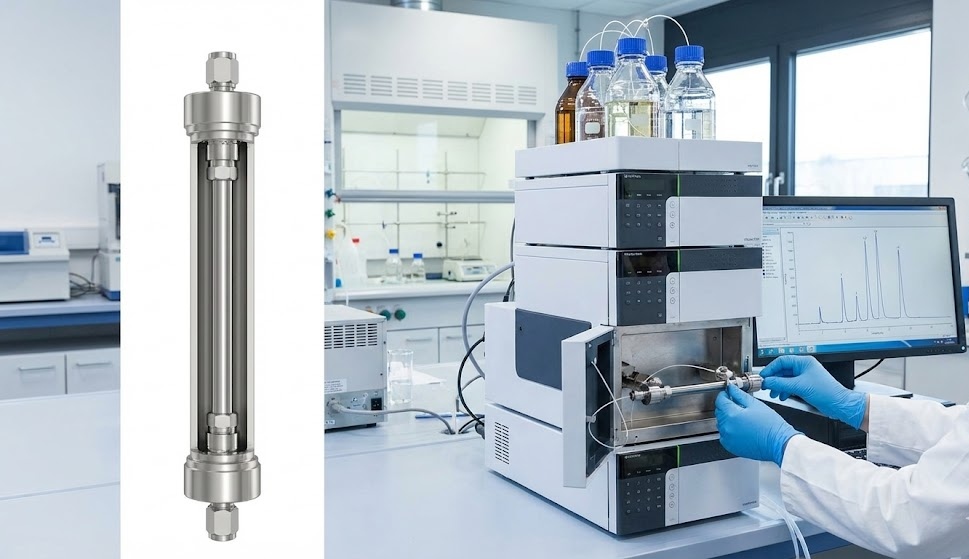
In the world of Analytical Chemistry, the High-Performance Liquid Chromatography (HPLC) system is the workhorse of the laboratory. However, if the HPLC instrument is the body, the HPLC column is undeniably the heart. Just as a heart pumps life through the body, the column facilitates the critical interactions required to separate complex mixtures into their individual components.
Whether you are a seasoned researcher, a quality control analyst, or a student stepping into the lab for the first time, understanding the nuances of the HPLC column is essential for achieving accurate, reproducible, and high-quality results.
This comprehensive guide delves deep into the anatomy, types, selection strategies, and maintenance of HPLC columns.
What is an HPLC Column?
At its core, an HPLC column is a specialized tube packed with a stationary phase material. It is the site where the actual separation occurs. When a sample is injected into the system, the mobile phase (solvent) carries it through this column.
The separation principle relies on the differential partitioning of sample components between two phases:
-
The Mobile Phase: The solvent moving through the column.
-
The Stationary Phase: The solid material packed inside the column.
As the sample travels through the column, different molecules interact differently with the stationary phase. Some stick to the packing material longer (high retention), while others flow through quickly (low retention). This difference in speed separates the mixture into distinct bands, which are then detected by the detector.
The Anatomy of an HPLC Column
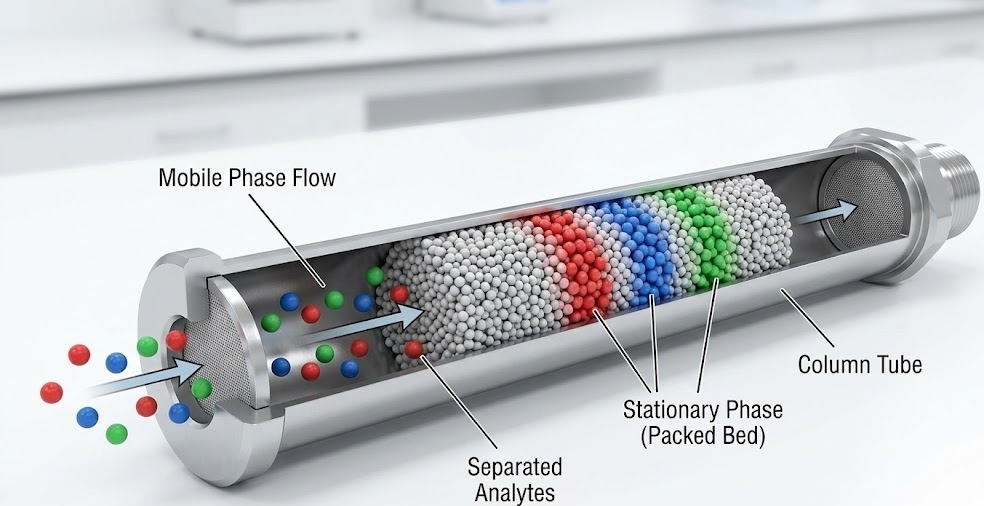
To understand how it works, we must look at how it is built. An HPLC column isn’t just a metal tube; it is a precision-engineered device consisting of four critical components:
-
Column Tube:
-
Typically made of high-quality Stainless Steel to withstand the immense pressures (often up to 6000 psi or more) generated during the process.
-
For bio-inert applications (analyzing proteins or biological samples), PEEK (Polyether Ether Ketone) tubes are used to prevent metal interaction.
-
Standard analytical dimensions often range from 50mm to 250mm in length with an internal diameter (ID) of 4.6mm.
-
-
Stationary Phase (Packing Material):
-
This is the most crucial part. It usually consists of porous silica particles or polymer beads.
-
These particles are chemically modified with functional groups (like C18 chains) to achieve specific separation characteristics.
-
-
Frits:
-
Located at both the inlet and outlet of the column.
-
These are porous disks (usually stainless steel or titanium) that keep the stationary phase inside the tube while allowing the liquid mobile phase to pass through. They also act as a final filter for particulate matter.
-
-
End Fittings:
-
These connect the column to the HPLC system’s tubing (injectors and detectors), ensuring a leak-free seal under high pressure.
-
Types of HPLC Columns: Separation Modes
Not all molecules are the same; some are polar, some are non-polar, some are charged, and some are massive. Therefore, different “modes” of chromatography require different columns.
1. Reverse Phase Chromatography (RP-HPLC)
“The Industry Standard”
Reverse Phase is the most widely used separation mode in pharmaceutical and environmental analysis.
-
Mechanism: It uses a non-polar stationary phase and a polar mobile phase.
-
How it works: Hydrophobic (non-polar) molecules in the sample are attracted to the hydrophobic stationary phase. The more non-polar the molecule, the longer it stays in the column.
-
Common Mobile Phases: A mixture of water (buffer) and organic solvents like Methanol or Acetonitrile.
-
Stationary Phase: C18 (Octadecyl), C8 (Octyl), Phenyl.
2. Normal Phase Chromatography
“The Old School Method”
-
Mechanism: Uses a polar stationary phase and a non-polar mobile phase.
-
How it works: Polar analytes stick to the polar column. Non-polar analytes elute first.
-
Common Uses: Separating isomers, tocopherols, or highly hydrophobic compounds not soluble in water.
-
Stationary Phase: Pure Silica, Amino, Cyano.
3. Ion Exchange Chromatography (IEX)
“For Charged Molecules”
-
Mechanism: Separates analytes based on their ionic charge.
-
Types:
-
Cation Exchange: Retains positively charged ions.
-
Anion Exchange: Retains negatively charged ions.
-
-
Common Uses: Analysis of proteins, peptides, nucleotides, and amino acids.
4. Size Exclusion Chromatography (SEC)
“Sorting by Size”
Also known as Gel Permeation Chromatography (GPC).
-
Mechanism: There is no chemical interaction. Separation is purely physical.
-
How it works: The stationary phase has pores of specific sizes. Small molecules get trapped in the pores and take longer to pass through. Large molecules are too big to enter the pores and flow straight through (eluting first).
-
Common Uses: Determining the molecular weight of polymers and proteins.
Decoding Common Stationary Phases
When you look at an HPLC column box, you will see codes like C18, C8, or CN. Here is what they mean and when to use them:
How to Select the Right HPLC Column
Choosing the wrong column can lead to poor peak shape, long run times, or zero separation. Follow this strategic approach:
1. Analyze Sample Polarity
-
Non-polar analytes: Use Reverse Phase (C18 or C8).
-
Polar analytes: Use Normal Phase or HILIC (Hydrophilic Interaction Liquid Chromatography).
-
Ionic/Charged analytes: Use Ion Exchange.
2. Determine the Purpose
-
Impurity Profiling: You need high resolution to separate the main drug from tiny impurities. Choose a column with smaller particle size (e.g., 3µm) and longer length (e.g., 250mm).
-
Assay/Potency: Speed and reproducibility are key. A shorter column (150mm or 100mm) may suffice.
3. pH Stability
Silica-based columns usually dissolve at high pH (> pH 8) and lose their bonded phase at low pH (< pH 2).
-
If your method requires a basic pH (e.g., pH 10), look for “Hybrid” or “Polymer-based” columns designed to withstand high pH.
4. Pore Size and Surface Area
-
Small Molecules: Standard pore size is 100Å or 120Å.
-
Large Molecules (Proteins): You need wide pores (300Å) so the large molecules can access the surface area.
HPLC Column Handling and Maintenance Tips
An HPLC column is an expensive consumable (often costing $500 – $1000+). Proper care extends its life significantly.
1. Always Flow in the Correct Direction
Columns have an arrow indicating flow direction. Running it backward can disturb the packed bed, leading to voids and ruined peak shapes.
2. Use a Guard Column
A guard column is a short, inexpensive cartridge placed before the main column. It acts as a sacrificial lamb, trapping chemical contaminants and particulate matter that would otherwise clog your expensive analytical column.
3. Filter Your Samples
Always filter samples through a 0.45µm or 0.22µm syringe filter before injection. Particulates are the #1 cause of high backpressure and column death.
4. Control the pH
Unless you have a specialized column, keep the mobile phase pH between 2.0 and 8.0. Outside this range, the silica backbone can hydrolyze (dissolve).
5. Proper Storage is Non-Negotiable
-
Short-term: If using the column again the next day, keep it in the mobile phase (remove buffers if present to prevent precipitation).
-
Long-term: Flush the column with a high percentage of organic solvent (e.g., 70% Methanol or Acetonitrile in water).
-
Why? Water promotes bacterial growth which clogs the column. High organic content prevents microbial growth.
-
Never store a column in pure water or buffer.
-
6. Avoid Pressure Shocks
Ramp up the flow rate gradually. Going from 0 to 1.5 mL/min instantly can shock the packed bed, causing channeling.
Conclusion
The HPLC column is truly the heart of the chromatographic process. While the pump provides the flow and the detector sees the result, it is the column that performs the magic of separation. By understanding the different modes of chromatography, selecting the appropriate stationary phase (like the workhorse C18), and adhering to strict maintenance protocols, laboratories can ensure data accuracy and prolong the lifespan of their equipment.
Whether you are analyzing life-saving pharmaceuticals or testing water quality, respecting the science behind the HPLC column ensures that your results stand the test of scrutiny.